Predatory Inclusion: How TalkLife Monetises Misery and Hides Behind a "Founder's Myth"

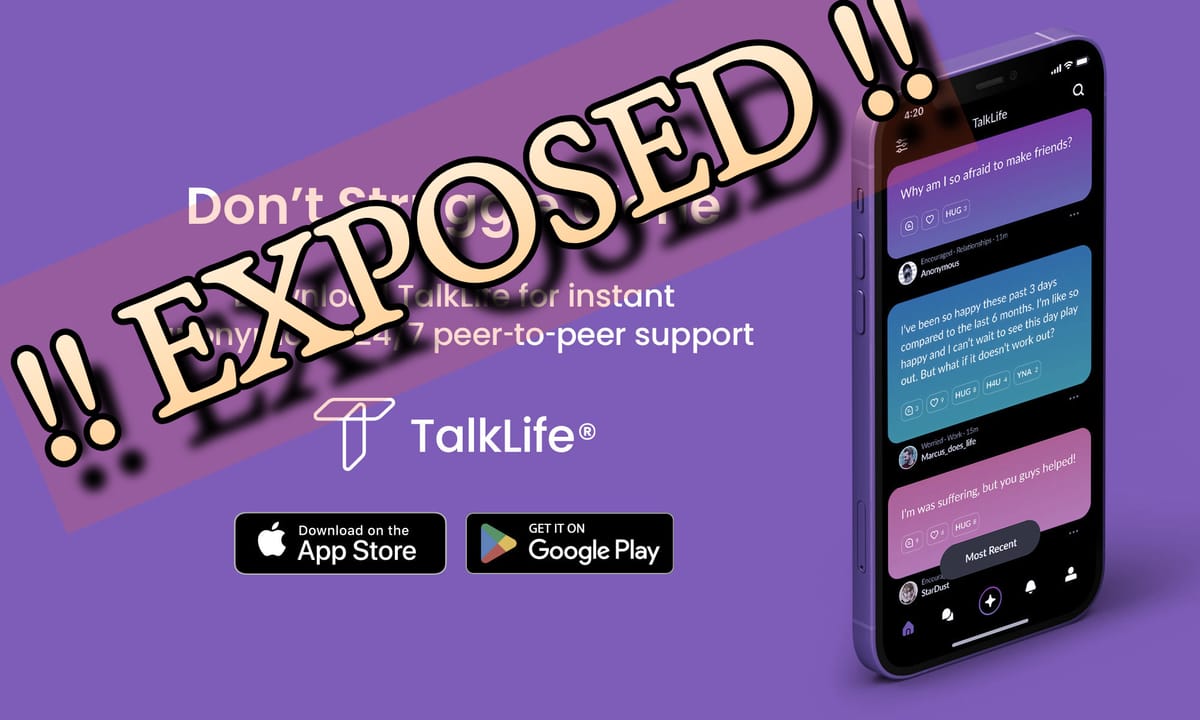
From "You're Never the Product" to Data Harvesting—A Case Study in Inhumane Tech.
When you are in a crisis—when the anxiety is overwhelming, or the depression feels like a physical weight—you are not looking for a "social network." You are looking for a lifeline. You go to the App Store or Play Store, desperate for connection, and you see it: TalkLife.
The branding is perfect. "Peer Support & Mental Health." "You're Not Alone." It promises a safe sanctuary where you can share your darkest thoughts without judgement.
But what if that sanctuary is actually a trap?
For years, I was a user of TalkLife. I went there seeking genuine help. I left feeling that my dignity had been stripped away, kicked out like "useless trash" for daring to question the system.
Driven by this experience, I decided to investigate. With the help of AI research assistants (Kagi and Google Gemini), I peeled back the layers of TalkLife’s "support" branding. What I found was not a community project, but a sophisticated corporate machine designed to extract value from human pain.
This is not just a review of a bad app. This is a case study in Predatory Inclusion—how modern tech companies invite vulnerable people in, only to exploit them for data.
The "Founder's Myth" vs. The CEO's Reality
Every good startup needs a story, and TalkLife has a powerful one. It is built around the "Founder's Myth" of Jamie Druitt. The story goes that he created the app because he was struggling himself and needed a safe place to talk.
This narrative is crucial. It acts as a psychological key. When we hear that the founder is "one of us," we lower our defences. We trust the platform with our most intimate secrets because we believe it is led by empathy, not profit.
But the reality of 2025 looks very different from that origin story.
While users are stuck in the loop of their trauma, relying on the app for daily survival, the "struggling founder" has effectively exited the struggle. A look at public social media profiles reveals a life of international tourism, happy photos, and smiling poses in exotic destinations.
There is nothing wrong with success. But there is something deeply unsettling about a CEO posing happily in tourist hotspots while his platform is funded by the "sad posts" of millions of users who cannot afford that escape.
And make no mistake: that lifestyle is funded by the platform. TalkLife is not a charity; it is a venture-backed company. It has raised millions from investors like TELUS Global Ventures and Bethnal Green Ventures. These investors do not put millions into "peer support" out of kindness. They expect a return on investment.
The "struggle" has become a brand asset. The pain of the users is the raw material that fuels the engine.
The Lie: "You're Never the Product"
During my time on the app, I encountered a specific claim that now haunts me. In a section of the app, there was a message from Jamie Druitt stating: "You're never the product".
In the tech world, this is what we call Privacy Washing. It is a comforting lie told to users to make them feel safe enough to share more data.
The evidence proves otherwise. TalkLife’s own business documents and privacy policies reveal that they operate on a multi-stream revenue model that relies heavily on... you guessed it: you.
- Data Insights: They generate revenue by providing "anonymised user data" and insights to researchers and other organisations. Your trauma, stripped of your name but still your story, is packaged into trends and sold.
- B2B Partnerships: They sell access to their platform to universities and corporations (via
TalkCampusandTalkLife Workplace).
You cannot sell data derived from user behaviour and simultaneously claim the user is not the product. We are the source of the asset. By telling us we aren't the product, they are creating a false sense of security. It is a deception necessary for their business model to work.
The Gamification of Misery
If the goal of TalkLife was pure peer support, the interface would prioritise calm, safety, and private connection. Instead, the app looks and feels like "Twitter for depressed people".
It uses the same dopamine-loop mechanics as Big Tech social media:
- Hearts and Likes: Validating your pain with digital points.
- Popular Pages: Creating a hierarchy of suffering.
- Follower Counts: Turning mental health into a popularity contest.
Why do they do this? Because high engagement generates more data points.
Every heart, every comment, and every refresh creates metadata that proves "user engagement" to their investors. If you were truly healed, you would leave the app. If you leave, their data stream dries up. They need you to be addicted to the app, not healed by it.
This is the Gamification of Misery. It keeps users hooked on a cycle of venting and validation, rather than guiding them towards recovery.
Sanitised for Profit, Unsafe for Humans
There is a dark paradox in how TalkLife moderates its content.
On one hand, they are incredibly strict about "graphic" content. Rules 5 and 6 aggressively ban details of self-harm or suicide. While they claim this is for safety, it serves a convenient corporate purpose: Liability Reduction.
Pharmaceutical companies and corporate partners want "sanitised" data—trends on anxiety and depression—without the legal messy bits of active suicide risks. By scrubbing the "ugly" truths of mental illness, they create a "clean" data product that is easier to sell.
On the other hand, the human element of moderation is failing catastrophically.
User reviews and reports are flooded with complaints about bullying, racist abuse, and grooming. Predators know that these apps are full of vulnerable people. Yet, reports of harassment often go unanswered, or victims are told to simply "block" their abusers.
They are hyper-vigilant about protecting their liability (the data), but negligent about protecting their users (the humans).
A Glitch in the Matrix: My Experience
My journey ended when I tried to speak the truth.
I commented on the disconnect I saw. I questioned the narrative. And what happened? Jamie Druitt’s user account blocked me.
I wasn't banned for breaking a rule; I was silenced because I was a threat to the brand. In psychology, we call this Institutional Narcissism. The response was cold, unempathetic, and unrepentant. They used a tactic known as DARVO (Deny, Attack, and Reverse Victim and Offender), blaming me for "agreeing to the terms" upon sign-up, shifting the liability solely onto me.
By blocking me, they weren't just avoiding negativity. They were engaging in Brand Protectionism. I was a "glitch in their matrix"—a user who woke up and saw the machinery. To maintain the illusion of the "Founder's Myth," they had to remove the critic who pointed out that the emperor has no clothes (but plenty of travel photos).
Predatory Inclusion: The Consent Trap
They will always say: "But you agreed to the Terms of Service."
This is the final defence of the exploiter. It relies on a concept called Predatory Inclusion.
When you sign up for TalkLife, you are often in a state of crisis. You are cognitively vulnerable. You are not in a position to critically analyse a 50-page legal contract about data sovereignty. TalkLife knows this.
By presenting a complex legal agreement to someone in distress, they are obtaining "consent" under duress. They are capitalising on the fact that you are too desperate for help to say "no" to the data harvesting. Legally, they might be covered. Ethically, it is entrapment.
Conclusion: Why We Need The Fediverse
I left TalkLife feeling like my dignity had been taken away. But they didn't take away my ability to find the truth.
This investigation has proven to me why my activism in humane-tech and the Fediverse is so critical.
As long as mental health platforms are centralised and for-profit, the user will always be the product. There is no way around the conflict of interest. A CEO with investors to pay will always prioritise engagement over healing.
We need alternatives. We need the Fediverse and protocols like Matrix. We need community-owned spaces where there is no CEO selling our "insights" to buy a plane ticket. We need spaces where data is owned by the community, not harvested by a corporation.
TalkLife may have the venture capital, but we have the truth. And we have the technology to build something better.
Author's Note: This analysis was conducted with the assistance of Kagi AI and Google Gemini, utilizing public review data and business model analysis.
Edit 1: A Warning on Information Control
I am certain that the censorship or information control teams associated with TalkLife will attempt to suppress this article.
But I suspect they will not do it by simply blocking this page. Instead, they will likely use a classic modern tactic: attacking the credibility of the message. When a corporation cannot disprove the facts, they aim to discredit the source. They will likely accuse this analysis of being "misinformation," "biased," or an "oversimplification" of their "complex mission". They will point to their terms of service and claim that everything they do is legal—which is exactly how Predatory Inclusion works.
They want you to doubt the author, the tools, and the truth you have just read.
So, I invite you to do your own research. Do not rely on blind faith in my words. Open your own AI assistant—whether it is Kagi, Gemini, or any other tool—and have a conversation about TalkLife’s business model. Ask about:
- Their revenue streams from "anonymised" data insights.
- Their relationship with venture capital firms like TELUS Global Ventures.
- The disconnect between their "safe space" branding and user reports of toxicity and grooming.
Go ahead, verify the facts for yourself. Then, come back to this article. If you find that the truth is different, I welcome the challenge. But I suspect you will find that the deeper you dig, the more the "Founder’s Myth" begins to crumble.
Edit 2: The Voices from the Ground—The Top 6 Criticisms
If you still doubt the machine behind TalkLife, look at the experiences of those who have used it for years. These points are not my "opinions"—they are the recurring themes found in hundreds of negative reviews from the Play Store.
1. From Sanctuary to "Dating App"
"Long-time users who were loyal for 7+ years report a devastating shift in culture. They describe a platform that has "conformed to social media" and now feels more like a toxic dating app than a mental health support group."
The "safe space" has been replaced by a "sick community" where meaningful interaction is rare.
2. Aggressive "Sanitised" Censorship
"One of the loudest complaints is the unfair and unclear censorship. Users report that admins remove posts for no reason, even when they are correctly tagged as triggering. This creates an environment where you are "only allowed to post if you are an influencer" and you are "ridiculed for being too sad"."
This confirms our theory: the data is being "cleaned" for B2B buyers at the expense of real venting.
3. The Arbitrary "Lifetime Ban"
"Loyalty means nothing to TalkLife’s management. There are numerous accounts of users being banned for life after 11 years of membership for "disagreeing with someone" or stating a "fact they didn't like"."
These bans often come without notice, warning, or a chance to appeal, making the app feel "like a jail" where you aren't free to speak.
4. Toxicity and Bullying (Protected by Admins)
"While the app claims to be a support network, users describe it as a "hook-up hot spot" where trolls and bullies "run rampant". Many claim that admins do nothing to stop racist abuse or bullying and instead "play favourites" or "retaliate" against those who complain."
This creates a "toxic and rude" atmosphere that is actively harmful to vulnerable people.
5. Persistent Technical Decay
"The app's performance is consistently described as "sluggish" and "glitchy". Users report constant "internal errors," server connection issues, and notifications that haven't worked properly for over a year."
These technical failings are not just annoying; for a crisis app, a "server not working" message can be the difference between someone finding help or feeling more isolated.
6. The Monetisation of Private Pain
"Crucially, users have started to see through the "you're never the product" lie. Reviewers explicitly call out that the app "sells our data and earns money," and that the constant push for "Dotz" and features nobody asked for proves the focus is on profit, not people."
My Final Question to You: When the very people seeking help are the ones calling the platform "abusive," "hostile," and "unfit for mental health," who is the app really for?
It's time to stop letting corporate "peer support" apps treat our struggles as a business opportunity.
Edit 3: The Philosophy of an Independent Activist
I have received some feedback regarding the style of this article—specifically about the lack of external links and my focus on personal narrative over "expert" reporting. I want to address this openly because it speaks to the very heart of why I am a disability and humane-tech activist.
1. Intentional Minimalism
The lack of links or external references in this essay is intentional. I refuse to clutter this markdown with brackets or symbols that direct you to external sites. More importantly, I will not be liable for suggesting links that may not be trusted or that could change over time. My focus is on the truth of the story here, in this space.
2. Activism vs. Expertise
Some expect the "polish" of professional journalism. But activism is primarily about spreading awareness and truth, not delivering expert-level reporting. I am an independent activist, not a corporate journalist. My skill is in spotting the harm and sounding the alarm. If this narrative inspires "experts" or professional journalists to do follow-up investigations, then my activism has succeeded.
3. The Oral Tradition of the Oppressed
In places like TalkLife, where censorship is the norm, the primary source of information is the "oral" testimony of the users themselves. This kind of victim-led documentation is a recognised and vital source of information, even by global bodies like the UN. The raw, unfiltered voices of those being bullied or exploited are more important than any sanitised corporate report.
4. Quality of Reach over Quantity
Finally, to those who ignore the points made here because they lack the reach of profit-driven reporting: I am not writing for the masses. I do not seek the high-volume engagement that these apps crave. If you choose to read, trust, and act upon this narrative, you are the person I am writing for. You are very welcome here!