The Glitch in the Wind: What a Virtual "Bank Angle" Taught Me About Systems and Control

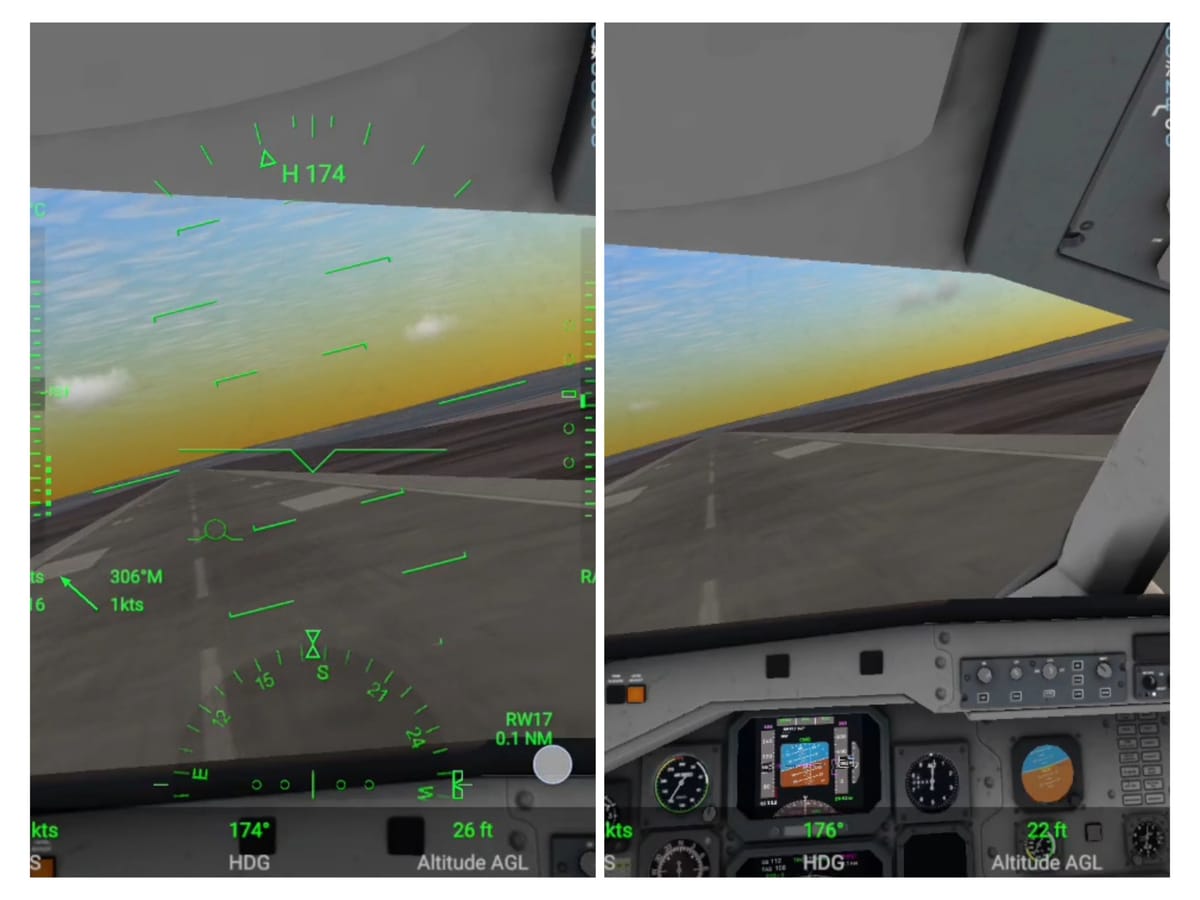
It started as a routine approach. I was sitting there with my phone, running Rortos’ Real Flight Simulator (RFS), descending towards a runway in Sarawak. The virtual cockpit was calm, the glowing instruments were steady, and the autopilot was locked onto the glideslope. It felt like running a clean script—predictable, logical, executed perfectly.
Then, just as the runway threshold came into view, the logic broke.
The horizon suddenly tilted violently. The nose of the plane swung right, drifting off the centreline as if an invisible hand had slapped the tail. My speakers blared a robotic, urgent warning: “Bank Angle! Bank Angle!” (At least, that is what I think it said—in the panic, it sounded like “back angle”).
My heart actually pounded. For a second, the immersion was total. I fought the controls, but the plane was fighting something invisible. Was it a bug? A glitch in the software? Did someone hack my session? It felt unfair, like the system was cheating me.
But as I sat back and analysed what happened, consulting with my AI thought partner, Gemini, I realised I hadn't been cheated. I had just been introduced to the chaotic reality of physics.
The Invisible Variable
My first instinct, as an IT student, was to blame the code. We are taught that if a programme fails to execute a task—in this case, landing straight—there is an error in the syntax. I suspected the game was broken or that the free version I was using had "nerfed" controls.
But Gemini offered a different perspective, pulling back the curtain on how these simulators actually work:
"It isn't just a random 'windy' setting; it is a complex data system... Microsoft and RFS use data from companies like Meteoblue or real-time METAR reports. If the weather station at Kuching reports a 15-knot crosswind from the North, the simulator 'injects' that exact wind into your game."
This wasn't a bug. It was a feature. The simulator was pulling live telemetry from the real world. Outside, over the actual skies of Sarawak, the monsoon winds were blowing. The simulator had simply taken that data—the "invisible variable"—and applied it to the 3D mesh of my aircraft.
I wasn't wrestling with bad code; I was wrestling with the actual atmosphere of Borneo.
Automation vs. The Manual Override
This incident forced me to rethink my reliance on "Autopilot." In the server world—where I spend time managing my self-hosted Docker containers—we love automation. We want scripts to handle the backups, the updates, and the routing. We trust the "Autoland."
But in aviation, as in life, automation has a hard limit.
I asked Gemini if I needed to disable the autopilot for these kinds of crosswind landings. The answer was a definitive yes.
"Autoland systems have strict limits... If the wind is stronger than what the computer can handle, the autopilot will struggle or even 'give up' at the last second... The computer follows a logic loop that isn't always fast enough for sudden gusts."
This resonated with me. The autopilot is just a script. It can handle the mundane, linear tasks of flying straight and level. But when the environment becomes chaotic—when the "gusts" of life or systemic injustice hit—the script fails. It cannot improvise. It tries to "crab" into the wind based on a calculation, but it lacks the intuition to "kick" the rudder at the last second.
That moment when the plane tilted? That was the autopilot failing to process the chaos. It was the moment the system threw up its hands and said, Error: Input exceeds parameters.
The Price of Control
I used to wonder why pilots are paid so much. It seemed like easy money to sit in a cockpit and let a computer fly the plane. But this virtual near-crash shifted my perspective entirely.
I mentioned to Gemini that perhaps pilots are paid "massive money" just so they can handle these overwhelming moments. Gemini agreed, framing it perfectly:
"Pilots are the 'manual override' for when nature becomes overwhelming... They are risk managers. When that 'Bank Angle' alarm goes off 10 feet above the ground, the pilot has less than a second to decide: Do I force the landing or go around?"
In that split second, a human being earns their entire salary. They are paid not for the hours of smooth flying, but for the ability to disconnect the computer, grab the yoke, and physically wrestle a 70-tonne machine onto the ground safely.
Just a Node in the System
There is a humbling lesson here for me. I often think about systems—whether it’s the servers I host, the "humane tech" I advocate for, or the societal structures I critique. I like to think I have control.
But sometimes, the crosswind is just too strong.
I am learning that it isn't "grandiose" to admit that I can't control the wind. I am, as I’ve said before, just one node among many. The wind blows, the server load spikes, the mental health struggles flare up like a sudden gust.
The "Bank Angle" warning wasn't a sign of failure; it was a reminder that I need to be present. I cannot just rely on the "autopilot" of daily routine. Sometimes, I have to take manual control. I have to apply the "rudder" to correct my course. I have to accept that the turbulence is real, not a bug.
As I look at my flight logs now, I don't see a failed landing. I see a successful test of the physics engine. The simulation was authentic. It didn't lie to me or coddle me with a perfect landing I didn't earn.
It gave me the wind, and it gave me the warning. The rest—the correction, the landing, the survival—was up to me.