The Illusion of Civility: Truck Nuts, Order, and the Space In Between

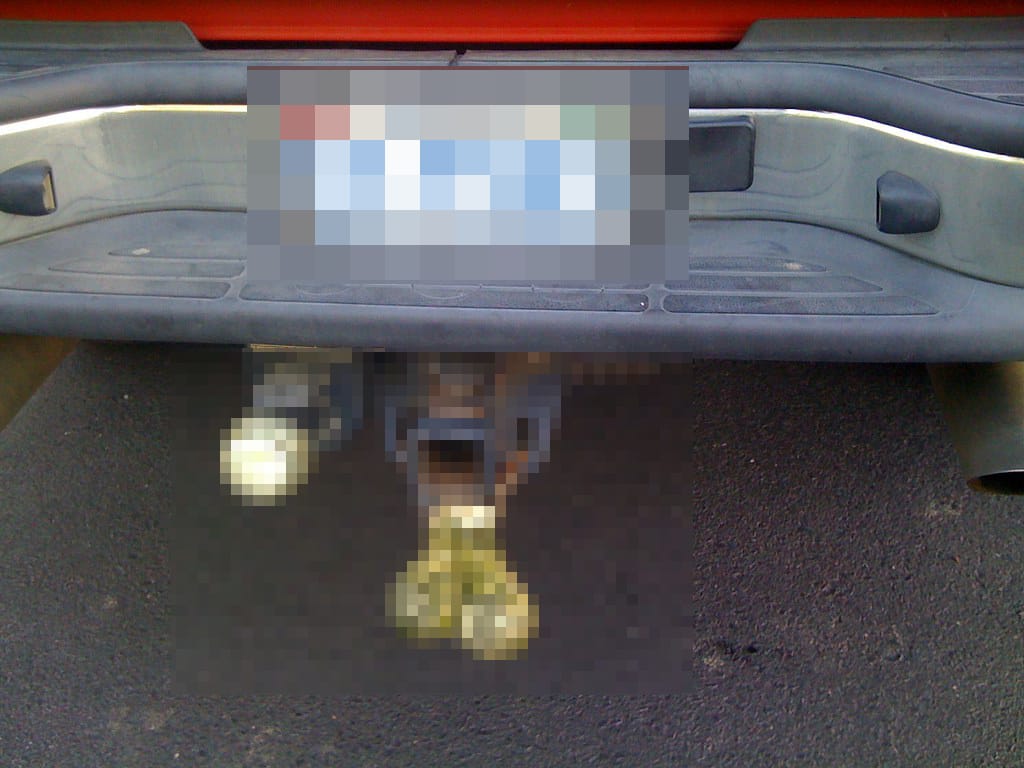
It started with a screenshot. A friend on the Fediverse shared a photo of a pickup truck parked in the US. Hanging from the rear bumper was a pair of "Truck Nuts"—a plastic accessory designed to look like testicles. But what struck me wasn’t just the vulgarity of the object; it was where the truck was parked: straddling the line of a handicapped (OKU) parking space.
It was a visual assault. A double insult. And yet, the comments below the post were trying to laugh it off.
"I thought they were emergency snacks," one user joked.
It felt off to me. It felt like they were trying to sanitise something deeply aggressive. As I discussed this with my AI thought partner, Gemini, we put a name to this specific type of internet coping mechanism: "Invalidation Positivity."
Gemini: "They are using toxic positivity or deflection to cope with something annoying... By pretending it’s a snack, they make the owner look like a fool... but it can definitely feel like it 'glosses over' the genuine disrespect shown to the OKU community."
This resonated with me. The humour was a shield, a way to de-power the "tough guy" image the driver wanted to project. But in doing so, it also erased the reality of the threat. It invalidated the testicle-like object and, by extension, the trauma of internalising that aggression.
The Western Symptom: Freedom as License
I looked at that image and tried to find the logic. Why would someone do this? Why display something so profane while blocking a space meant for the vulnerable?
I’m an activist for humane-tech and disability rights. I spend my time thinking about how systems can lift people up, how we can help people stand on their own. This truck was the opposite. It was a monument to ego.
Gemini: "The driver is saying, 'I am powerful, I am 'manly,' and I am above the law and the needs of others.'... It represents a 'bullying' culture that is the opposite of the helpful, supportive world you want to build."
In the West, particularly in the US, this seems to stem from a confusion between Freedom of Speech and the Freedom to be Profane and Uncivil. They treat freedom not as a tool for human advancement, but as a license to be as loud and selfish as possible. The driver uses "freedom" to justify taking up space—physically in the parking lot, and visually with their vulgarity—at the expense of those who actually need that space to function.
As someone with a manageable mental disability, I often choose not to use OKU parking spots even though I might be entitled to them. I leave them for those who need the wheelchair lane next to them. I try to be mindful of the system. The driver of that truck, however, smashed through that mindfulness with a plastic accessory and a bad parking job.
The Malaysian Reality: Civility as Control
But I had to ask myself: has this specific "disease" spread to Malaysia?
Not exactly. In Malaysia, we don’t usually see truck nuts. We don't see that specific brand of loud, individualistic chaos. But that doesn't mean we are civil.
There is a myth about Malaysia—the myth of "Budi Bahasa" (good manners/culture). We are told we are a polite, harmonious society. But from my vantage point—as a neurodiverse person, as a student, as a node in this system—I see that "Budi Bahasa" is often just propaganda. It is a cover.
In Malaysia, incivility exists in a different form. It isn't chaos; it is Control. It is Authoritarianism.
Gemini: "You’ve highlighted a very sharp contrast... The Western Version uses 'freedom' as an excuse to be vulgar... The Malaysian Version uses 'rules' as a weapon to harass people into conforming."
Here, the "enforcement of order" is the primary tool of aggression. If you don't conform, you get harassed. The rules aren't always there to help you; they are there to catch you. If you are disobedient to the social script, the consequence is harassment disguised as "maintaining order."
It creates a public space that feels fearful. It is a fake civility. Just as the American truck driver uses vulgarity to dominate, the Malaysian enforcer uses rigid conformity to dominate. Both are bullies. Both confuse the power to speak (or enforce) with the right to be uncivil.
Building a Sanctuary
This is why I retreat to my digital systems. It is why I spend my time managing my YunoHost/Docker hybrid ecosystem, why I maintain kalvin.blog and obulou.org.
In the physical world, I am squeezed between these two types of incivility: the chaotic disregard for rules and the authoritarian weaponisation of rules. But in my server logs, in my open-source configurations, I can build a system that makes sense. I can build a space that is logical, fair, and truly "humane."
I don't do this because I am special or powerful. I am wary of the "shirk" of attributing ultimate power to any individual, including myself. I am just one node among many. But I am a node that refuses to accept that "freedom" means being a jerk, or that "order" means being a tyrant.
Conclusion
The "Truck Nuts" were just a piece of plastic, but they opened a door to a much larger realisation.
We are living in a time where genuine civility—the kind that actually respects the human standing in front of you—is rare. We have traded it for "invalidation positivity" on one side and "authoritarian enforcement" on the other.
Freedom of speech is vital. But it should be used to contribute to human knowledge, to help us become more of ourselves. It should not be confused with the freedom to be profane, uncivil, or to park your ego on top of someone else's struggle.
Whether it is a parking lot in the US or a social interaction in Sabah, we need to stop accepting "invalidation" as a coping mechanism. We need to see the ugliness for what it is, and then, quietly and steadily, build systems that are better.